Showing posts with label writing. Show all posts

Monday, October 12, 2015

IT'S RELEASE DAY


Friends, today is a BIG, BIG DAY!

It’s RELEASE DAY!

Wow. It feels really weird to say that. It’s TODAY?

Honestly, it doesn’t even feel real.

Although a lot of times I have OHMYGOD I’M SO OLD WHAT AM I DOING WITH MY LIFE AAAAH thoughts, the truth is I’m only twenty-three years old, and so I can say with quite a bit of certainty, today is the most important day of my life.

Sure, Jane may never be a New York Time’s Bestseller or have a movie made out of her or be added to Fanfiction.net so people can write weird slash stories about the characters (wait, what, those aren’t all aspiring author’s dreams?) but writing JANE UNWRAPPED has given me more than I could ever ask for. So being that it’s Canada’s Thanksgiving today, here are five reasons why I’m thankful for Jane Unwrapped:

1. Jane taught me perseverance. Writing a book is not easy. Editing one is even harder, and getting people to take a chance on your work? Near impossible. I always refer to Jane as a labour of love, because she was indeed a labour. So many times I would have preferred to just watch television or gone to bed or hung out with friends, but Jane was waiting and she came first. Jane has turned me into a master prioritizer and multi-tasker, and although there’s no end in sight, I am so thankful for the ability to achieve all of my goals through the perseverance Jane taught me.

2. Jane taught me patience and persistence. There’s a whole lot of hurry up and wait in the writing game. Waiting for query responses, waiting for revisions, waiting for responses from agents and editors and publicists and reviewers. And a lot of time, what you’re waiting for does not turn out to be good news. Throughout the three-year journey with Jane, we held our breath only to be disappointed a lot of times. But she taught me that the good news is definitely worth the wait and all the “nos” in the world can’t begin to overcome the feeling of one “yes”.

3. Jane connected me with so many amazing people. The writing community is infinitely large and yet very tiny all at once, and Jane gave Leah and I a chance to be a part of it. From the amazing writer friends we’ve made, to the incredibly kind Booktube and book blogger community, to the immensely talented people we’ve had a chance to work with, Jane has given us an opportunity to meet some of the absolute best people in the world.

4. Jane is the first chapter of a long book. There is absolutely nothing I love more than writing and shaping a story. My dream is that one day I can make a living living in imaginary worlds. And I know that a writing career is not built on one book (unless you’re very lucky!), so Jane is the very first step in building my dream life.

5. Jane crossed off a big bucket list item. I do believe you should write for the love of writing, for the story within you that desperately needs to be told. But still, Leah and I wanted to get published. We wanted others to laugh at Jane’s quirkiness, and Tut’s arrogance, and Anubis’s awkwardness. We wanted someone else to feel what Jane felt. And thanks to a lot of hard work, a dash of luck, the amazing people at Entangled, and of course, to the readers, we accomplished something we had only dreamed about.

To be honest, when I started writing this post, I thought it would be quite whimsical and excited and goofy. Instead, I almost feel a bit nostalgic, for all the times it was just Leah, I, and Jane. It’s a little scary sending her off into the big-bad world. And yet, I could not be more grateful for this journey, and ultimately, this ending.

And, of course, because it is release day, here is everything JANE UNWRAPPED!
Some tombs should never be opened… 

Fluorine uranium carbon potassium. Jane’s experiment really went wrong this time. After a fatal accident, teen scientist Jane becomes the first modern-day…mummy. Waking up in the Egyptian underworld without a heart certainly isn’t the best—especially when it means Anubis, god of embalming, has to devour her soul. Yuck. But when Jane meets the drop-dead gorgeous god, suddenly she’s thinking this might not be the worst thing to happen. And then she is pushed to do the impossible—just time-travel and kill King Tut. Well, every experiment has variables which can end in disaster… Jane just wishes she could decide whether she wants to strangle Anubis or kiss him.

Purchase JANE UNWRAPPED here 
Purchase Paperback copy here
Connect with Leah and Kate here

Thanks for reading, friends! So, because it is Thanksgiving after all, what are you thankful for?


Thursday, August 27, 2015

Leah Kate Write Newsletter!


Hey guys! We've just created a newsletter so that we can keep you up-to-date with all the latest news, exclusive content, and a chance to win free stuff! Sign up now and share with your friends because one week today we will be sending out the first chapter of our debut novel JANE UNWRAPPED!

We hope to send you e-mails once or twice a month. We want to include exclusive stuff from our books plus writing tips and tricks.

What sort of things do you like in a newsletter? Let us know in the comments below!

Click HERE to subscribe or look to your right at the side bar!


Wednesday, August 5, 2015

Five of the Most Badass Egyptian Gods


Mythology is pretty darn cool. Whether it’s the Greeks, the Romans, the Nordics, or the countless other pantheons out there, hearing the stories of powerful gods acting with human emotions is enticing. When doing research for our novel, Jane Unwrapped, Leah and I became captivated by the lore and legends in ancient Egyptian religion. Here are our picks for the five most badass Egyptian gods.

1. Anubis: We’ll start this off with the god of embalming, Anubis. This jackal-headed god is the protector of the dead, and is associated with the ancient ritual of mummification. Although one of the oldest and most documented gods in Egyptian mythology, Anubis actually doesn’t feature in the lore too much. Instead, his image decorates pretty much every tomb in Egypt. He was considered one of the most loved gods because of endless protection and care for the souls passing through the Duat.


2. Isis: Isis is the goddess of health and wisdom, as well as the wife (and sister) of Osiris. She was seen as the ultimate mother and wife, as well as a friend to anyone from slave to the pharaohs. She also had sick magical powers involving resurrection and nature. Isis is badass because not only did she have a huge following back in ancient Egypt’s day, but she’s also one of the only ancient gods to still have a huge cult following today!

3. Osiris: Osiris is considered the god of the dead, but is also associated with life. If this seems contradicting to you, it’s because the Egyptians saw death as just a gateway to the afterlife, where your soul would continue living on. Because the greenish-black colour of the Nile floodplain represented rebirth and fertility to the Egyptians, Osiris is lucky enough to have green skin. Osiris is really cool because he’s considered the merciful god of the underworld. He observed all the souls coming into the afterlife, where their hearts would be weighed to see if the were pure enough to go to paradise.

4. Nephthys: Isis’s sister, Nephthys is the goddess of death, and is associated with nighttime and mummification. Nephthys was seen as the other side of the coin of Isis: one for life, another for death. This does not been Nephthys was not as loving or caring as Isis; she was equally as important and powerful. Nephthys stars in her own bit of soap opera lore as well: unable to get pregnant from her infertile husband, Set, Nephthys disguised herself as Isis in order to get Osiris to sleep with her. When Nephthys had her baby, Set was so furious, she abandoned the child to make sure Set didn’t kill him. Thankfully, Isis adopted the child…who she named Anubis! How’s that for drama?

5. Aten: You may have heard the names of the other four gods thrown around if you’ve read anything about Egypt, but I’d wager you haven’t heard of Aten. That’s because Aten was a lesser sun god, completely over-shone by his more famous counterparts, Ra; Amen; and Horus. Now Aten is badass because they (Aten was considered both male and female) caused a complete religious upheaval. Akhenaten, nicknamed the heretic pharaoh, reigned over Egypt from around 1353–1336 BC. During his reign, Akhenaten abandoned all the gods except for Aten, and moved the capital of Thebes to a city built for worship of Aten. He also happened to be married to Nefertiti and father of King Tut! Also his religious revolution didn’t stick, Aten’s effect over the pharaoh still makes him one of the most interesting gods.

 If you enjoyed learning about the Egyptian gods, let us know in the comments below, and we’ll post some more interesting facts about ancient Egypt! And if you’d like to see these gods in action, stay tuned for our book Priestess of Anubis (Entangled Teen Crave) where these gods (and more!) cause trouble for a modern-day girl.

Thanks for reading!

Video Version


Monday, July 6, 2015

Five Ways to Generate Writing Ideas


If you’ve never had a bout of writer’s block, you haven’t been writing for long enough. Whether you love to outline and don’t know what happens next, or if your plot is lacking some pizazz, you may just need a little helping pumping your author juices. Here are our go-to solutions when we need a little inspiration!

1. Go for a walk with someone: Being co-authors, Leah and I have an advantage by having two minds to brainstorm, but mostly it’s just sprouting ideas back and forth that really gets us the best idea. Having a sounding board, whether it be your mom, best friend, critique partner, or even your dog, is helpful because it gets you spewing out ideas and hearing them out loud. Plus, grabbing some fresh air and getting your blood pumping is great to rejuvenate a foggy brain!

2. Take a nap: Don’t get too excited; you have to stay awake! But one of the most fun ways to work out the plot is to make a playlist of music that inspires you or fits your story and just daydream. If you find yourself replaying the same scenario in your head, you’ll know you have an enticing scene to write. I find this idea also works great in the shower or on a bus, too!

3. Play a game: This is something Leah and I do not only to generate ideas but for fun as well! We write the names of all our characters of our current project and put them in a bowl. Then, we write a bunch of settings, such as “On a bridge” or “In the rain” or “In jail” and put those in a bowl. Finally, we write down a bunch of verbs, such as “Kissing” or “Fighting”, and put those in a bowl. We draw one setting, two verbs and two characters, then put a ten-minute timer on. We both write a random scenario using our drawn cards! Even if this doesn’t generate a plausible plot solution, it’s a great way to get your writing juices flowing, get into character, and practice your voice! Plus, some of the stories come out HILARIOUS.

4. Experiment with a different medium: Sometimes it helps to put your story on a different kind of page; Leah loves to draw scenarios or characters from our current project, and often finds this helps her discover something new about the plot or character. If drawing isn’t for you, modify it. If you like making music, try writing a theme song for your book. Even a vision board on Pinterest helps you visualize your creations and can spark new ideas!

5. Make it history:
One of the absolutely best ways to iron out plot snags or get ideas is to borrow from history. Our world and the people in it are fascinating and history has inspired many epic books. For example, Tolkien is famously inspired by Anglo-Saxon folklore, and George R.R. Martin’s A Song of Fire and Ice is a fantastical take on the War of Roses. Leah’s and my book Jane Unwrapped (Entangled Teen Crave) was so fun and exciting to plot because the Egyptian history of the time was dramatic enough for a book without our help making up new ideas!

If you have any secrets to generating ideas, let me know in the comments!

Tuesday, June 23, 2015

WE'RE GETTING PUBLISHED


Hey guys, so we have some pretty crazy and exciting news!
Our novel, Jane Unwrapped, is going to be published by Entangled Teen Crave!
WHOOOOOOOOOOOOOOOOOOOOOOOO

So this is exciting for plenty of reasons, including:
1.)  We have been working on Jane since 2012. That’s three years of focus on one story.
2.)  Entangled is a SUPER COOL publisher, with tons of books we love, and is totally right up our alley as far as future projects go
3.)  This means that someone will read Jane who we’re not forcing/begging/paying!

If you haven’t heard about our novel yet, Jane Unwrapped is a young adult mythological fantasy. Dying and being turned into a mummy is not the kind of experiment teen scientist Jane thought she would be conducting; especially now she’s trapped in the Egyptian underworld. If that’s not bad enough, the snarky (but outrageously handsome) god Anubis is sworn to devour her heartless soul. When Jane discovers her only ticket out of the underworld is to go back in time and steal the heart of King Tutankhamen, she poses as a priestess and befriends the young pharaoh. Between trying to murder her new friend and being stalked by Anubis, who can’t seem to decide if he’s going to kiss her or kill her, Jane has to make a choice: do the logical thing and steal the heart of the pharaoh, or listen to her (metaphorical) heart and find a way to save herself and Tut…even if it means rebelling against the gods of Egypt in the process.

If you'd like to learn more, we also made a vlog announcement! We’re going to be updating with lots of blogs and vlogs about the process of getting published/publishing, so please stay tuned for lots more information! As always, don’t forget to follow us to keep in the loop :)


Thursday, April 9, 2015

5 Things Writers can Learn from Game of Thrones


1. Deal Your Characters the Worst Hand — and watch how they bloom (or buckle!) under the pressure. Common writing advice is to never give our characters a break, but how many of us actually do it? It’s time to take out your frustration and make your characters the punching bag. Think about the very worst thing that could happen to your characters and do it. Jaime Lannister got his sword-hand chopped off, Sansa Stark was forced to marry into the family that killed her parents, Jon Snow had to live with the Wildlings to save the wall. Figure out what your character’s greatest fear is and exploit.


2. Say Goodbye in the Most Permanent Way — G.R.R. Martin is notoriously known as the Character-Killer, and he does it will pizazz. But don’t go lobbing off your character’s heads off willy-nilly. There has to be a reason that moves the story forward. Ned Stark’s death was one of the most brutal and mind-blowing in the series, but his death was a catalyst for the rest of the series.

3. Repetition Rocks — Catchphrases and repeated prose are a great way to help create the world and give your book a tone that’s uniquely yours. Repeated phrases can not be used to create an important motif in the book, but they can also be a way to tie your reader into the world. Winter is coming, the night is dark and full of terrors, a Lannister always pays his debts: these are all GOT signatures that are not only important to the story, but are also fun to say at parties!

4. Environment Can be a Character — The Song of Fire and Ice books are rich in detailed descriptions of setting and environment. From the cold of Winterfell, to the stifling city of King’s Landing, to even objects such as the Wall: these environments have description and backstory which make them seem like a character all of their own. This makes Westeros feel alive.


5. There’s No Such Thing as Heroes and Villains — One of the most amazing things about A Song of Ice and Fire is your never truly sure who you’re rooting for…the characters are so distinctly fleshed out that it’s hard to name one as truly heroic and truly villainous. Sure, there’s the consistently valiant Jon Snow, and the insane Joffrey, but name any other character, from Tyrion to the Hound to Arya Stark, and you’ll find a long list of noble and despicable things on their resumes. By making your characters flawed and morally-struggling, it can help the reader relate to them, and make your antagonist a more varied and realistic character.


6. BONUS: Sometimes a prologue can work. Martin does a prologue right. He adds a completely different layer to the first chapter, as well as sets up a plot line for the entire series.

Sunday, January 25, 2015

The Magic of a Book Hangover


There’s no more bitter-sweet a feeling than a book hangover: the emptiness that echoes in your body after finishing a book and are jerked back into the harsh reality of the real world.

On one hand, there’s a sense of accomplishment: I did it. I finished the journey. I travelled the pages of this book, navigated between the words, lived and breathed with these characters. It’s truly like being Bilbo Baggins, arriving in the Shire after traveling with the company of dwarves. You know you will never be the same again, and there’s a sense of magic in that revelation.

But there’s also a twinge of melancholy because you know you will never be the same again; a part of you still belongs in the book world. The characters you journeyed with seem more real than your friends and family. A book hangover is like culture shock, being torn from one land into another before you were ready to say goodbye.

I can think of many occasions where a book has wrecked and ruined me for the real world, from the sporadic crying fits that wracked me for the next three days after finished Philip Pullman’s The Amber Spyglass to the emptiness of leaving Middle-earth behind after my father read out the last words from Return of the King. And even though I’m back in the real world, I feel a small part of me remains in those books too.

And there is the sweetness: knowing a part of you stays with the magic forever. What books have given you a book hangover? Let me know in the comments!

Tuesday, January 20, 2015

When the Branch Breaks: A Post about Rejection


The last year and a half has been pretty awesome. I’ve entered a program in school I’m really excited about, Leah’s on the adventure of a lifetime in Australia, and we’ve written a new novel that we’re in love with.

However, there was one big thing we focused on the last year: acquiring an agent to represent our young adult novel, JANE UNWRAPPED. But we weren’t querying, entering Twitter contests, or doing any other typical things an aspiring-author might be doing. Since the fall of 2013, we had been engaged in a review and revise with a certain agent, and throughout the year, focused only on these revisions.

This agent turned the book from a gigantic pile of word garbage to a fast-paced epic. We were flabbergasted at how she knew the story better than us, and we were so excited about every new draft. The notes she provided were extensive and detailed, and although we hadn’t signed, in the back of our minds, we thought there was no way she would spend so much of her time and energy on our manuscript without intention to sign.

But then, we didn’t hear from her for almost fives months.

It’s submission season, we said. Then: it’s the holidays, no one works during the holidays! Then: it’s after the holidays, so she must be catching up on other stuff. A week after sending our second nudge, we received a reply.

The agent replied that her client list had grown too large and she no longer had the time to dedicate to our novel.

Reading the email was like a blow to the stomach. I’ve never had an issue with rejections—in fact, they’re something Leah and I collect like badges of honour, laughing at each new one. But this was different. We had dedicated a year and a half to this one person’s vision of our book, and in our minds, we already considered ourselves a team.

It felt like I had been climbing a tree, clambering up the branches, and finally, I could see the top. I was still a few branches away, but the sunlight was streaming through, and I was reaching, reaching, reaching, just about to grab that last branch—

And then someone sawed off the branches I was holding onto, and I tumbled down towards the earth, collapsing on the ground. And all I could do was look up at how far there is to climb…

My significant other—a musician, so no stranger to creative rejection himself—said to me, after I gave him my tree-climbing analogy: “Turns out the branch snapped because the tree was rotting and you couldn’t tell that from the bottom. So now you can go find a new, healthy tree to climb, and you’re like five times better at climbing.”

As much as I want to dwell in my sadness, anger, frustration, and disappointment, it won’t make the agent change her mind. The book is miles better than it was this time last year, and the waiting time gave us the opportunity to write our new novel, which we’re super stoked about.

So what happened when I received that rejection? I sat and stared at it for a while, and then I cried that powerful, ugly kind-of cry that you save for only the worst occasions, and then I dried my face and sat down at my computer and wrote a new query letter.

I start climbing.

Wednesday, December 31, 2014

How to Accomplish Absolutely Anything


It’s a bold claim, isn’t it—that this blog is the key to accomplishing absolutely anything in your life? Perhaps it is bold, but that’s what this blog is all about: finding ways to achieve your biggest dreams and to change your life.

Like a genie granting three wishes, there are limitations, but the following skill is one of the most important things I have ever learned and I guarantee it can help you manage stress, achieve your dreams, and improve your life. And being that it’s a new year tomorrow, there is not better time to implement this life-changing skill.

So how do you accomplish absolutely anything?

Proper goal-setting.

Via www.thestudentacademy.ca
I truly believe our lives are in our control, but we’re hindered by circumstance, motivation, and distractions. Proper goal-setting treads a path that leads us to the life we want. This step-by-step guide, inspired by psychologist Gerard Egan’s skilled helper model, is easy and fun to do!

Before we begin, I’m going to establish the rules of proper goal-setting. Your goals must:

1.) Be something you have control over
2.) Have a timeline
3.) Be measurable


For example, “I want to sell my book to a Big 6 publisher and become a famous author” is not a valid goal because it does not contain the three necessary qualities for success. However, “I want to finish writing my manuscript by January 31st” has all three of the qualities for a successful goal.

Ready to accomplish something awesome? Grab a piece of paper and a pen and follow along…

Step 1: Brainstorm Statements of Good Intention

Use your piece of paper to write down as many statements of good intentions as you possibly can! Statements of good intentions are just things you would like to do. Think broad and go until you’re out of ideas!

Examples: I want to finish writing my book, I want to run a successful blog, I want to make new friends, I want to travel, I want to exercise more, I want to spend more time with my family, I want to get a new job, etc.

Step 2: Choose between 2-4 Statements of Good Intentions.

You don’t want to overwhelm yourself with too many goals, but you also want to start 2015 off right, and you want to challenge yourself. Choose the most important things on your list and write them down. I’ll use the statement of good intention of “I want to finish my novel” as a building block for the next examples.

Via www.thestudentacademy.ca
Step 3: Create a broad goal

Now, we’re going to narrow down our statement of good intention into a more manageable goal.

Example: “I will make writing my novel a part of my daily routine.”

You may notice your statement of good intention can be broken into many broad goals. For example, a statement of good intention of “I want to be healthier” could have broad goals of: I want to start running, I want to drink more water, or I want to eat more vegetables. Choose one and direct your attention on that. After you create a detailed plan to achieve that goal, you can move onto the next one.

Write your broad goals down for each statement of good intention.

Step 4: Create a specific goal

In this step, you create a very specific goal based off of your broad goal. Try to be as detailed as possible.

Example: “I will write 1000 words of my novel everyday”.

Write your specific goals down for each broad goal.

Step 5: Create a manageable goal

In this step, we put timelines on our specific goals to make sure we can judge our progress.

Examples: By January 31st, I will have written 30, 000 words of my novel.

Write your manageable goals down for each specific goal.

Step 6: Create plans to achieve your goals.

Take a good look at your measurable goals and think about the barriers in the way of achieving them. Then, write down steps you can take to help you achieve your goal. For example, if your specific goal is to start running regularly three times a week by the end of the month, a barrier may be a lack of self-discipline. A plan to overcome this may be to join a running group that will hold you accountable. This step may be different for each goal, but try to write out about 3 plans for each goal.

Example: Barriers to writing 30, 000 words of my novel by January 31st include a hectic schedule and distraction from family and friends. My plan to overcome these barriers is:
1) I will set aside a certain time each day to write.
2) If I know I will be busy in the days coming up, I will write more on other days to maintain my word count goal.
3) I will tell friends and family members so they understand when I need time to write.
4) I will treat myself to a night out on February 1st if I achieve my goal.
Via www.thestudentacademy.ca

And that’s it! 

Remember, goals are meant to challenge you! You have the ability to inspire yourself and achieve anything in the world. Goals are a map to the heart. Good luck! Please share your goals with me and have a happy, healthy, adventurous 2015! There is much excitement on the horizon.

Sunday, December 28, 2014

Seven Steps to Mostly Painless Editing


I can definitely relate to the image here! I had always thought that writing the first draft was the longest and most time-consuming step of writing a novel - did Eternal ever prove me wrong! Here are my tips on doing a thorough editing job:

Picture


1. Create a detailed outline.
I know there are a lot of "pantsers" out there who just like to start writing and see where it takes them, but I am certainly not one of these people. I strongly believe the more work you put into your outline, the easier the whole process is - for me, at least. If you work hard on a sturdy, thorough outline, it'll save you tons of headaches in the future when it comes to plot holes and pacing. I learned this the hard way.

2. For the first draft, just type.
If I ever make it big, I'm putting the inventor of Write or Die in my acknowledgements. It's a website that you write in, has no spell or grammar checker, records how long you've been writing for and how many words you've written...oh yeah, and punishes you if you stop writing. First drafts are supposed to be raw and gritty and full of gems buried beneath poor grammar and awkward sentences. It's all about getting the characters out of your brain and walking around on their own.

3. Rewrite, rewrite, rewrite.
Once I have my first draft down, I rewrite the entire book. Okay, maybe retype is a better word for it. But essentially, I rewrite the book into a new word document, smoothing out sentences, changing around scenes, and adding or cutting things in order to improve the plot. Some scenes remain similar, and others are unrecognizably.

4. Print it out.
There's something about staring at a piece of paper compared to a computer screen that changes the way you think. Step 4 is my favourite part of the revision process: I print the entire book out and read it out loud. I mark typos, inconsistencies, scenes that don't work, and awkward dialogue. Reading your own work out loud is eye-opening: things that sounded good in your head just don't make sense once given breath. I find this step fun and rewarding: you finally get to see a complete manuscript that is more-or-else complete. All your hard-work is beginning to pay-off!

5. Implement the changes.
This is where I go back to my word document and make all the changes I had written on paper. If certain scenes need to be completely re-written, I'll go back to Step 3.

6. Final readthrough.
Are you sick of your book yet? In this step, I read the whole thing on the computer again, just double checking to make sure the manuscript is as strong as possible.

7. Share your work!
Whoo, this step is fun, exciting, nerve-wracking, and frustrating! Here's where you bug your mom, your dad, your friends, your critique partner, your writing group, whoever you want, to read your book. There's nothing like talking about your book with someone who just finished reading it. There's no feeling like someone generally enjoying the journey you took them on.

Well there you go: my Seven Steps to Mostly Painless Editing! Of course, you may need to do these seven steps several times, but this will definitely get your book in tip-top shape. If you'd like to see a condensed version, check out our video for some more editing tips!

 How do you guys do your editing?

Sunday, November 16, 2014

The Five Stages of NaNoWriMo (Star Wars Style)

Hey guys, Kate here! Sorry for my absence, but I’m sure as many of you can relate, it has been a crazy month trying to keep on top of NaNo! I’m a little ashamed to admit that I am behind—between school and work, I’ve had a hard time getting in my daily word count. Nevertheless, I’m a fairly good sprinter, and I just got to keep utilizing my tips and tricks, so I know I’ll just have to put in some crazy days towards the end of the month!

Although this is my first year participating in NaNo, I have written over 50, 000 words in a month and witnessed Leah’s various NaNo wins, so I felt pretty comfortable writing this blog. We’re just over halfway through the month, so let me know if you’ve gone/are going through these various stages.
You don't know what you're getting yourself into, young one

1.) The Eager Padawan (Nov 1st-5th):
you’re freshly plucked off the barren desert planet where you haven’t written anything recently, or been stuck editing, or just been working on the same thing. You see a new horizon: a huge challenge that you are SO ready for. You got your lightsaber…er, pen, at your side and you are ready to kick some butt!


2.) The Disgruntled Jedi Knight (Nov 6th-15th): Okay, maybe this Jedi thing is a little harder than you thought. Maybe you’ve fallen behind, or are just barely making your word-count. You’ve stared at a blank page for longer than you’ve been writing, and your fingers are starting to cramp when you first wake up. And the rest of the month looms like a desert full of Tusken Raiders ahead.

3.) The Desperate Dark Apprentice (Nov 16th-25th): Calling it “overwhelmed” is saying the least. You’ll do anything to make the first half of the month worth all the hard work, even join the dark side. You hate this book, this month, the world. Now, the rest of your life starts to slip away as you realize your daily word count is only getting bigger and bigger. And yet, a dark pride rises in you. As the dishes start to pile up, the book is the only thing that matters,

4.) The Dark Sith Lord (Nov 26th-29th): Sun…what…what is that? You’ll do anything to complete your word count, even kill younglings if you need to! You’ve truly given yourself to the power of the NaNo. There’s so much writing that needs to be done, and yet life wants to get in the way. Sweat pours down your neck at every moment, for every second away from your laptop is a second wasted. Your eyes are bloodshot, your hands tremble, and the end gets closer and closer.

My allegiance is to my word count, to the completion!
5.) The Redeemed Master (Nov 30th): You did it. Yes, yes, possibly at 11:59pm, you did it. You wrote your 50,000th word and finally the Force is brought into balance. A sense of relief, pride, and exhaustion hits you. It’s been a long journey, and possibly you weren’t always at your best, but you wrote like the true Jedi master you are.

Good luck NaNoing everyone! Let me know how it’s going in the comments!

Wednesday, October 22, 2014

5 Tips to Getting the Most Out of a Writers' Conference


Hello, friends! Kate here.

I wanted to write a follow-up post in my entry on the Surrey International Writers’ Conference. I can honestly say going to that conference was one of the most important and positive things I did as a writer. However, at the same time, it can be a tremendously overwhelming experience. Whether you’re a first-time conference attendee or just looking to get a little more out of your next conference, here are five tips to help you rock any writers’ conference!

1. Prepare, plan…and play it by ear. Take it from a couple o’ gals who tried to wing their first conference—getting your stuff together in advance will save you a whole lot of stress. Take a good look at the workshops and presenters; highlight the ones that are most important to you. Research the agents and editors attending. Know which ones represent your genre, and make note of their names and a few of their clients. And perhaps most importantly, have your work in order. Leah and I spent the night before the conference madly editing our first draft, crafting an elevator pitch, and printing out pages in the hotel lobby. Make these things part of your packing list so you’re ready to go before the conference even begins. That being said, don’t be afraid to switch up your plan. You may really connect with a certain presenter and want to switch to their workshop, or catch an opportunity to pitch your book or talk with someone important.

2. Put your party pants on and get ready to mingle. Hey, us writers are happy hermits but once a year, we gotta crawl out of our dark holes, look wistfully back at our blinking computer screens and say, “Well, manuscript, I’m going out.” I am definitely not comfortable meeting strangers or starting conversations, but getting out of your comfort zone and making new connections is so important. Connecting with other authors is a great way to build a community of people who understand you and will support you through your ups and downs. Also, you never know who you’ll end up meeting. On our last dinner at the Surrey International Writers’ Conference in 2013, an agent sat beside Leah and I. After talking with him all evening, he asked what our book was about, and ended up requesting a full! Even though he didn’t end up offering representation, he sent us a detailed letter with critiques that really helped us improve the book. Without making that personal connection, we would have never received such important feedback!


3. Pitch pitch pitch pitch pitch. Alright, this point depends on where you are in the writing process, but if you are at a conference with a fully-edited novel and you are ready to query…for goodness sakes, pitch the crap out of that book! Pitching face-to-face is a great way to judge an agent’s initial reaction to your premise as well as to catch their attention. If you have the opportunity to buddy-up with someone, have them take notes for you at the workshop so you can make the most of meeting agents and wooing them with your fantastic book! At SiWC, Leah attended the workshops so I was able to pitch as much as I could. We ended up with ten requests by the end! That’s way better than what we would have done if we just sent out good ol’ regular email queries.

4. Rest, relax, and enjoy it. It’s so easy to get over-stimulated by everything going on: pitches and workshops and fancy dinners and people to meet. Yes, you’re at a conference to promote your work, but don’t forget that this is supposed to be fun! You’re here because you love writing and it brings you joy—don’t lose that pleasure by stressing out about everything. Give yourself time to go up to the hotel room and take a nap or just rest you mind. Have a conversation with your lunch-mates about something totally un-writing related. Look around and enjoy the fact that for this one weekend, you’re not in reality. Any SiWC alumni will know the feeling when the emcee Carol puts on her dinglehoppers and all of these strangers are suddenly your friends, sharing an inside joke. Enjoy that moment.

5. Bring the magic home. When you leave a writers’ conference for the first time, I guarantee something inside you will change. You’ll suddenly be full of inspiration, hope, revelation. Don’t let that magic die out once you get back to reality. Remember why you were there and the feeling of being surrounded by your people. Remember that you are a writer.

To all those attending SiWC this year, best of luck and have a great time at the greatest writers’ conference on Earth! To anyone else attending conferences in the future, hopefully these tips help you to get the most of what I’m sure will be an amazing experience.

Let us know in the comments your tips and tricks at any writers’ conference!


Tuesday, October 21, 2014

What To Expect When You're Expecting...a trip to the Surrey International Writers' Conference!

Hey guys, Kate here.

Well, it's my favourite time of the year...time for the Surrey International Writers' Conference! For those who don't know, SiWC is an absolutely incredible conference for writers of any genre to meet, mingle, learn new skills, sharpen their old ones, and pitch their stories to agents and editors! Leah and I have been twice, and both times were absolutely incredible! As heartbreaking as it is to say, Leah and I are unfortunately not able to attend this year. Between Leah's impending travels and the situation of our current project, it just wasn't a financially-savvy thing for us to do. So to try to fill the void of missing our favourite activity, we dug up our discarded blog posts from our first conference in 2012. If you're a first-time attender wondering what to expect at your first conference or a SiWC veteran gearing up for pitches and parties, take a look below:

Kate's Post:

This Day We Write! 
I know my sister just posted a blog on the Surrey International Writers’ Conference, but it was such an overwhelming and amazing experience that I can’t help but want to publically share my thoughts on the entire thing as well. The SiWC was just an unbelievable experience, filled with positivity, energy, and hope. I left feeling electrified and invincible!

I’m not going to lie, I had my doubts about the conference before we arrived. I thought we weren’t ready to pitch our story yet, we hadn’t had enough time to perfect our writing, that we simply weren’t prepared enough to make the most out of it. I see now that nothing was farther from the truth, and I was just afraid. Thank goodness I had the constant optimism of my sister and the immense support of our parents, otherwise I would have bagged the whole thing and said, “Maybe next year!” for the rest of my life! I don’t believe our book will ever be 100% done, but somewhere along the way you just have to accept it and give it a go.

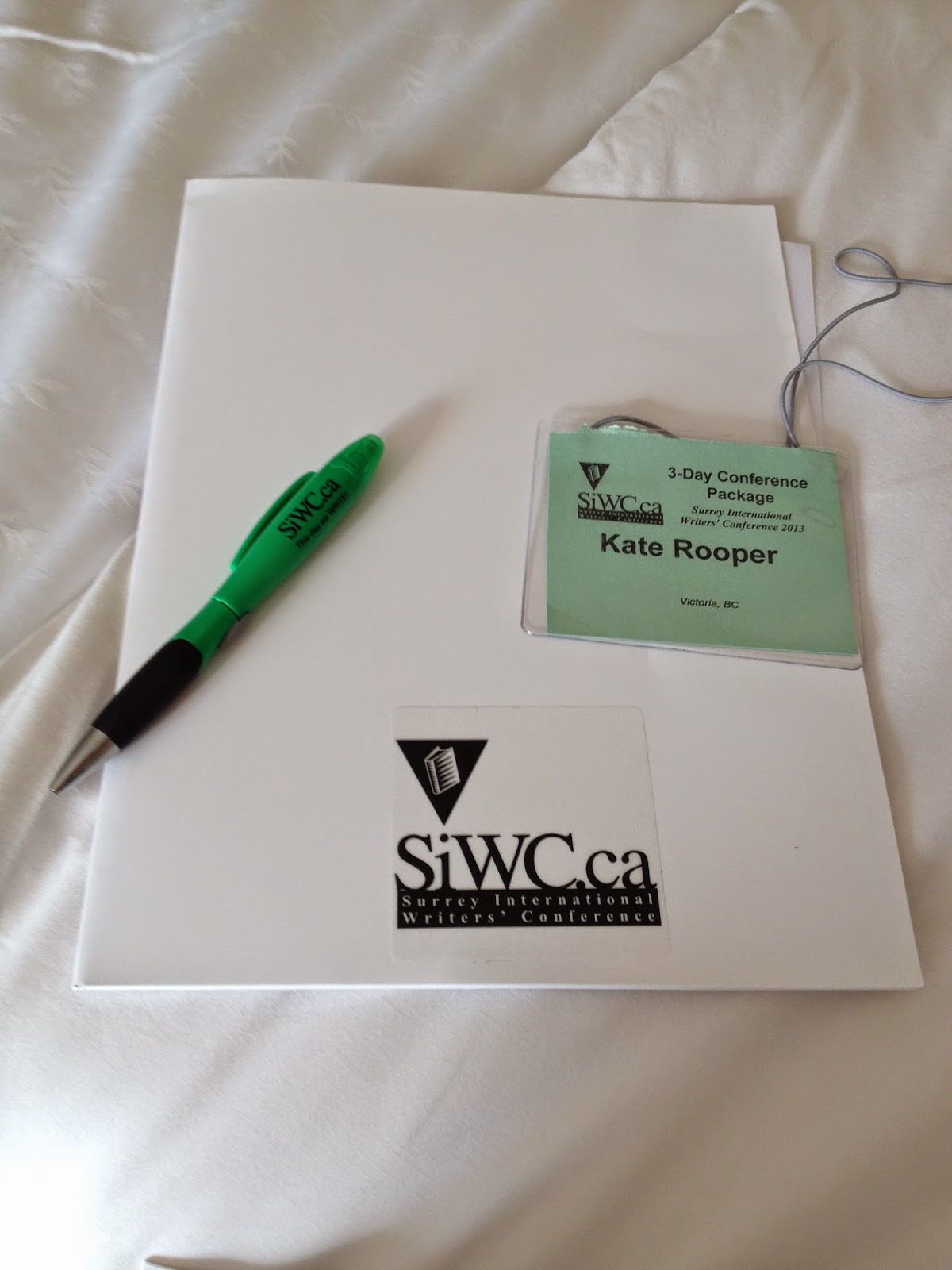
First of all, I love Vancouver! Even though it’s similar to Victoria, there’s always that feeling of Big City possibility as soon as the car pulls off the ferry. Our hotel was quite lovely with the comfiest pillows you have ever laid your head upon. We debated trying to smuggle one home but it wouldn’t fit in our suitcase. Registering with the con and getting our official SiWC folders and pens just heightened the excitement! (Oh, and not to mention we saw fantasy author Sam Sykes checking in at the desk so I had to fangirl-squee a bit.)

I was a bundle of nerves the first day, but relaxed when I saw how outgoing and friendly everyone around us was. Leah and I are not social Olympians, so making friends and small talk is not our forte. Lucky for us however, everyone else seemed more than happy to introduce themselves and break the ice.
The keynote speaker Friday morning was Jane Espenson, so being an uber Buffy-Angel-Game of Thrones-Once Upon a Time fan, I was in awe. Next, I sat through awesome workshops where I learned the do’s and don’ts of pitching (EXTREMELY helpful!) and heard some great thoughts on villains and conflict. During the conflict workshop, I received my first high-light of the trip: a text from my sister that read,
I got an appointment with Jack Whyte!!!!!!!
Omg
Aaahh.
Reply
Reply
Reply
Reply
Jack said, “Well, after tearing that to shreds, I can tell you it’s very good.”

Meeting Jack was one of our hopes for the conference, but having him review our work was more than we could possibly dream! And, he said it was good. In his Scottish accent.

Incredibly, I got a last-minute pitch session with a certain agent that I really wanted to meet. Not so incredibly, Leah and I had not yet crafted our pitches yet and had to do so in 20 minutes. Incredibly, it came out sounding quite exciting! And even more incredibly, I was able to say the 40-second pitch without vomiting all over the table or bursting into tears (both of which I wanted to do). And even more incredibly, she said she wanted to read it! At first I was in shock, then denial (Oh, I’m sure she just says that to everyone so as not to hurt their feelings), then I decided to just accept it as a great thing and celebrate! Our very first query ever resulted in a request!

And what better way to celebrate than with a drink at dinner? Which were, by the way, delicious. Being a vegetarian, I was astounded by the amount of meat-free dishes they had, all which were incredible! And the company was even better. Talking about my work in a professional setting was extremely inspiring. I have so many supportive friends and family members in my life who I constantly lean on and talk about my writing with, but when I brought up our books to these new colleagues, I actually felt like I wasn’t discussing a hobby anymore – I was discussing a career path. I was discussing a lifelong dream.

Saturday went by just as wonderfully with some beautiful keynotes, another successful pitch where an agent requested the first three chapters of our novel, and an extremely helpful and hilarious Blue Pencil editing session with Sam Sykes. Oh, and Jack Whyte called us beautiful, and what better compliment is there than one said in a Scottish accent?


Leah's Post:

I am on the ferry ride back from Vancouver. Wow, what can I say, the conference was amazing! For a long time, all I’ve heard is great things about the SiWC and now I know why! Above all else, the atmosphere was great there; I didn’t once talk to a person that wasn’t friendly and supportive! In case any of you are thinking of going I’ll write some notes on different aspects of it:

Blue Pencil Café: So for those of you who don’t know the Blue Pencil Café is where you get to sit down with a published author and they go over three pages of your work with you. My first appointment was with romance novelist Sheila Roberts, and even though I brought a YA sample with me, she was SO nice and helpful! She gave me the name of her agency and told me to email her when my book was finished. On the way out, I decided on a whim to see if Jack Whyte had any free appointments. It turns out he did…right then! Luckily I had the first three pages of my and Kate’s YA fantasy with me as well. I can tell you right now, you’ve never really heard your stuff read out loud until its read by Jack Whyte. If you’ve heard him speak, you’ll know what I mean! I was terrified the entire time, but at the end (after stopping multiple times to tweak things) he said: “Well, after ripping that apart I can tell you it was good.” I was so excited! The 15 minutes just flew by. I would recommend blue pencils to anyone; the advice you’ll get is invaluable

Pitch Sessions: Pitching for me was the most nerve-wracking part of the whole conference! I definitely need to work on calming down my nerves. I had my 40-second pitch practiced, and when I sat down, I think I just threw it all up (figuratively!) on the poor agent. She was very nice though, and even though she didn’t request any pages, she gave me her card and told me to email her if I had any questions. Kate had a bit more luck with the agents (she was pitching the same book with the same pitch so if anyone asks I’m going to claim I just had bad luck!) and we got a request for 50 pages and 3 chapters! So we’ll be busy fixing those up!

Workshops: I really enjoyed all the workshops. I liked the idea that you could float between them if you wanted, and leave for appointments. I’d have to say my favorite (and most helpful) was pitching 101, Complex Conflicts, SiWC idol, and the Secret Lives of Best Sellers. I enjoyed everyone I went to and wish I could have cloned myself to go to more!

The Banquets: Our mother was extremely kind and bought Kate and I the full package including all the meals. For anyone who’s thinking of going I’d highly recommended it. The key speeches alone were one of my highlights of the conference, two of the speakers almost brought me to tears! Not to mention the people you meet, everyone is so interesting. Plus one of the meals you get to eat with a presenter. Not to mention the food was VERY good.

Plus there were so many great things about the conference that I haven’t even mentioned, such as getting to hear Jane Espenson’s speech, bumping shoulders with everyone in the elevators, and the hotel beds were super comfy too! I’ve never been to another writer’s conference, but I can’t imagine one being any better. I had the time of my life and hope I can go back next year!